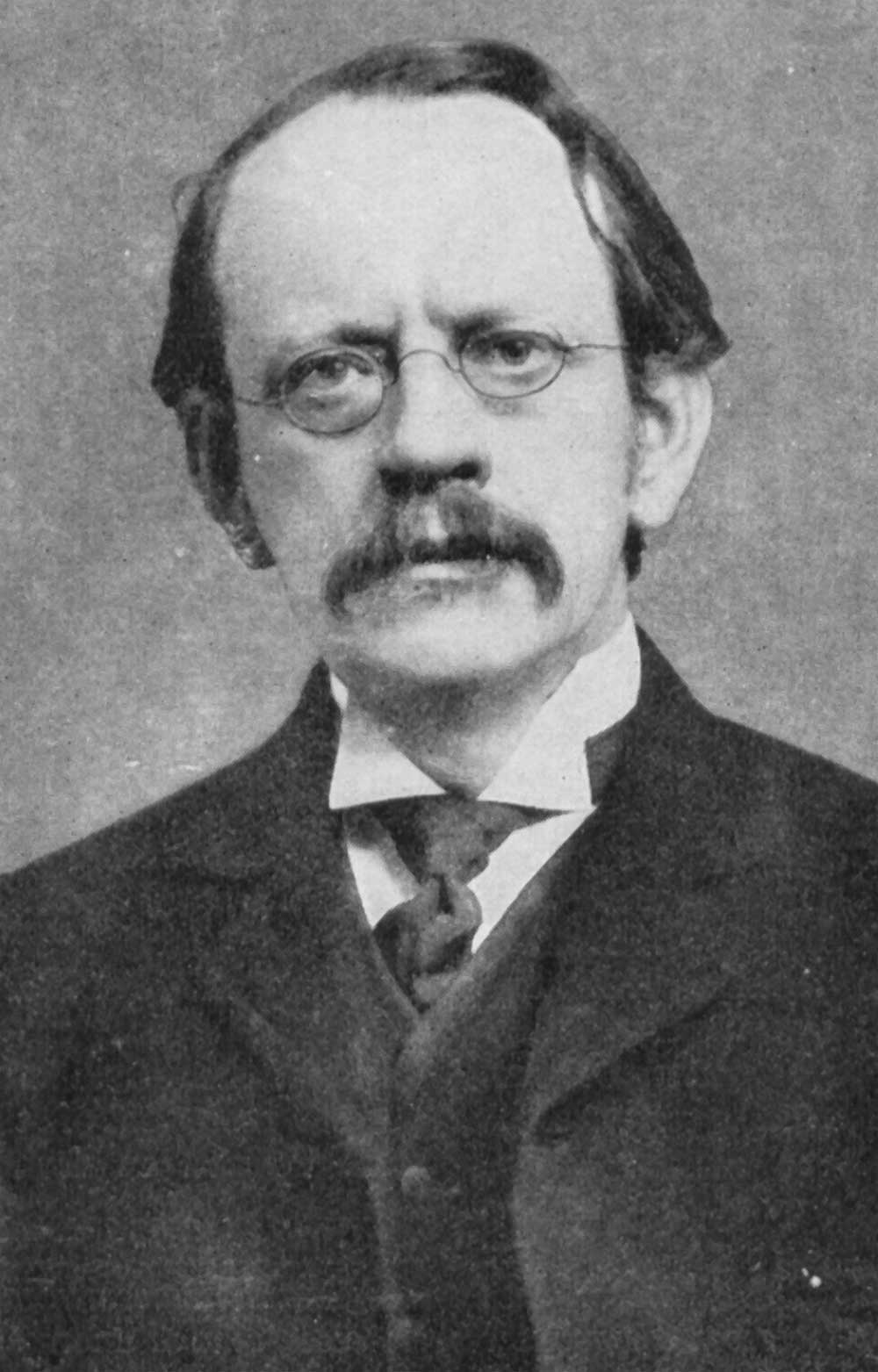
 Sir Joseph John "J.J." Thomson (December 18, 1856 – August 30, 1940) was a renowned British physicist and Nobel laureate best remembered for his discovery of the electron,
the first subatomic particle.
Sir Joseph John "J.J." Thomson (December 18, 1856 – August 30, 1940) was a renowned British physicist and Nobel laureate best remembered for his discovery of the electron,
the first subatomic particle.Queer Places:
University of Cambridge, 4 Mill Ln, Cambridge CB2 1RZ
Westminster Abbey, Dean's Yard, London SW1P 3PA, United Kingdom
Sir Joseph John "J.J." Thomson (December 18, 1856 – August 30, 1940) was a renowned British physicist and Nobel laureate best remembered for his discovery of the electron,
the first subatomic particle.
Born in Cheetham Hill, Manchester, Thomson entered Owens College (now the University of Manchester) at the young age of 14. In 1876, he moved to Trinity College, Cambridge, where he built a brilliant academic career, taking a degree in mathematics as the Second Wrangler in 1880.
In 1884, at just 27 years old, Thomson was unexpectedly chosen to succeed Lord Rayleigh as the Cavendish Professor of Experimental Physics at Cambridge. In 1897, through his pioneering work with cathode rays, he demonstrated that rays were composed of negatively charged particles—which he called "corpuscles," later known as electrons. This fundamental discovery revolutionized physics and earned him the 1906 Nobel Prize in Physics.
Thomson served as the Master of Trinity College, Cambridge, from 1918 until his death. He was knighted in 1908. In 1890, he married Rose Elisabeth Paget, daughter of Sir George Paget; the couple had two children, George Paget Thomson (who also won a Nobel Prize in Physics) and Joan.
The Cambridge Apostles is a prestigious, secret intellectual elite society founded at the University of Cambridge in 1820.
Composed primarily of undergraduate and graduate scholars from Trinity and King's Colleges, the Apostles met weekly behind closed doors to debate philosophy, ethics, science, and politics.
While many legendary Cambridge figures—such as Bertrand Russell, John Maynard Keynes, and Ludwig Wittgenstein—were members of the Apostles, J.J. Thomson himself was not a central or well-known member of the society. His life was heavily anchored in conventional Victorian academic structures, mathematics, and experimental laboratory physics.
While J.J. Thomson lived a conventional, heteronormative family life married to Rose Paget, the Cambridge Apostles and the broader Cambridge ecosystem with which he was associated have profound historical links to LGBTQ history:
From the late 19th century through the early 20th century, the Apostles became famous for providing a safe space for homoerotic discourse, aestheticism, and frank discussions of male-male love as an intellectual counterdiscourse to strict Victorian sexual morality.
Many prominent figures associated with Cambridge and the Apostles—such as Lytton Strachey, John Maynard Keynes, E.M. Forster, and later members of the Bloomsbury Group—used the society and university networks to openly or discreetly explore same-sex relationships.
These LGBTQ cultural currents flourished heavily among the humanists, philosophers, and literary figures of Cambridge decades after Thomson entered the university. Thomson's own legacy remains purely scientific, tied to the Cavendish Laboratory rather than the socio-sexual countercultures of the Apostles.
References:
Support this project
This website is a passion project researched, developed, and funded entirely by me. If you find the content valuable and would like to help support the ongoing research and hosting costs, any contribution is deeply appreciated.
Thank you for keeping this independent resource alive!
My books on Amazon: Elisa Rolle's books